


Introduction
The rivalry between the India national cricket team and the South Africa national cricket team is one of the most competitive and entertaining contests in international cricket. Over the years, both teams have produced outstanding performances, memorable victories, dramatic finishes and individual records that have attracted cricket fans worldwide. Their encounters have taken place across Test matches, One Day Internationals (ODIs) and Twenty20 Internationals (T20Is), with each format adding a different dimension to this sporting relationship.
The history of these two cricketing nations goes back to 1991, when South Africa returned to international cricket after the end of its sporting isolation. Since then, India and South Africa have developed a strong cricketing rivalry based on talented players, contrasting playing conditions and competitive team performances. India has traditionally been particularly strong at home, while South Africa has built a reputation for its pace bowling, athletic fielding and ability to compete in challenging overseas conditions.
The India national cricket team vs South Africa national cricket team timeline provides an interesting picture of how this rivalry has developed over more than three decades. From the first ODI encounter to important Test series, World Cup meetings and recent T20 competitions, the two sides have repeatedly demonstrated why their matches are considered major events in international cricket.
Early History of India vs South Africa Cricket Rivalry (1991–2000)
The beginning of the rivalry dates back to November 1991, when South Africa toured India for an ODI series. This tour was historically important because it marked South Africa’s return to international cricket following years of exclusion. The first ODI between the two teams took place in Kolkata on November 10, 1991. India won the match by three wickets, creating the first memorable result in a rivalry that would become increasingly competitive.
South Africa’s first Test tour of India came in 1996, but the two nations had already faced each other in Test cricket during South Africa’s 1992–93 tour. The first Test began in Durban on November 13, 1992. South Africa won the opening Test series 1–0, demonstrating its strength in home conditions. The South African side featured talented cricketers who were capable of challenging India’s batting lineup through pace, discipline and consistent bowling.
During the late 1990s, South Africa generally enjoyed an advantage in international cricket between the teams. Players such as Sachin Tendulkar, Mohammad Azharuddin, Allan Donald, Shaun Pollock and Jacques Kallis became important figures in the developing rivalry. India’s batting quality was impressive, but South Africa’s bowling attack often made conditions difficult, particularly on pitches offering bounce and movement.
The 1996–97 season was another important period because India secured a 2–1 Test series victory at home. However, South Africa responded strongly during the return tour and won its home Test series 2–0. These contrasting results established a pattern that would continue in later years: India often performed confidently on familiar pitches, while South Africa remained a difficult opponent in its own conditions.
Important Developments Between 2001 and 2010
The first decade of the 2000s brought several important changes to the rivalry. Both teams developed stronger batting lineups and more experienced bowling attacks. India began producing competitive performances outside the subcontinent, while South Africa continued to rely on a combination of disciplined fast bowling, dependable batting and excellent fielding.
One significant moment came during India’s 2001–02 tour of South Africa. The hosts won the Test series 1–0, continuing their strong record at home. However, India gradually improved its ability to compete against South Africa in difficult overseas conditions. Experienced players such as Rahul Dravid, Virender Sehwag, VVS Laxman, Anil Kumble and Sourav Ganguly contributed to the team’s development.
The 2004–05 home series was another important chapter. India won the two-match Test series 1–0, demonstrating the benefits of its improving batting depth and spin-bowling strength. The team was becoming more confident in home conditions and increasingly capable of challenging South Africa’s experienced players.
In December 2006, the rivalry entered a new phase with the introduction of T20 International cricket between the nations. India won their first T20I encounter by six wickets in Johannesburg. This match was especially memorable because it formed part of the early development of India’s T20 cricket identity. The shorter format created opportunities for aggressive batting, innovative bowling and exciting finishes.
The 2007–08 Test series in India ended in a 1–1 draw, while the 2009–10 series also finished level. These results reflected how evenly matched the teams had become in longer-format cricket. By the end of the decade, the rivalry was no longer defined by South Africa’s earlier advantage alone. India had developed the confidence and resources to compete consistently against the Proteas.
India vs South Africa Timeline: Major Cricketing Milestones
The following table highlights important developments in the rivalry across different periods. It focuses on historically significant encounters and series rather than listing every international match.
| Year or Period | Important Event | Result or Significance |
|---|---|---|
| 1991 | First ODI encounter | India won by 3 wickets |
| 1992–93 | First Test series | South Africa won 1–0 |
| 1996–97 | Test series in India | India won 2–1 |
| 2004–05 | Test series in India | India won 1–0 |
| 2006 | First T20I encounter | India won by 6 wickets |
| 2010–11 | Test series in South Africa | Drawn 1–1 |
| 2015–16 | Freedom Trophy in India | India won 3–0 |
| 2017–18 | Test series in South Africa | South Africa won 2–1 |
| 2019–20 | Test series in India | India won 3–0 |
| 2021–22 | Test series in South Africa | South Africa won 2–1 |
| 2023–24 | Test series in South Africa | Drawn 1–1 |
| 2025–26 | South Africa’s tour of India | South Africa won Tests 2–0 |
These milestones demonstrate how the rivalry has developed through different generations of players. They also show that neither side has maintained complete dominance across every format and playing condition.
The Growth of the Rivalry During 2011–2020
The period between 2011 and 2020 was particularly important for the development of India–South Africa cricket. Both teams had established international stars, experienced captains and players capable of changing matches individually. India’s batting lineup featured Virat Kohli, Rohit Sharma, MS Dhoni, Cheteshwar Pujara and Ajinkya Rahane, while South Africa had prominent performers such as AB de Villiers, Hashim Amla, Dale Steyn, Faf du Plessis and Kagiso Rabada.
The 2010–11 Test Series: A Competitive Battle
India’s 2010–11 tour of South Africa produced one of the most competitive Test series between the two nations. The three-match series ended in a 1–1 draw, with both teams recording important victories. India demonstrated its ability to challenge South Africa in difficult overseas conditions, while the home side showed why it was considered one of the strongest Test teams of that period.
The series was particularly significant because India’s experienced batting lineup managed to compete against South Africa’s formidable fast bowlers. The performances of Sachin Tendulkar, Rahul Dravid and other senior players helped India remain competitive. This series became an important reference point in the India national cricket team vs South Africa national cricket team timeline because it showed that India could challenge the Proteas even on their home grounds.
The 2015–16 Freedom Trophy: India’s Dominance at Home
The 2015–16 Freedom Trophy was another memorable chapter. South Africa arrived in India with a strong squad, but the home team dominated the four-match Test series, winning 3–0. The matches were largely influenced by spin-friendly pitches, where Indian bowlers such as Ravichandran Ashwin and Ravindra Jadeja played crucial roles.
India’s victory demonstrated how effectively the team could use home conditions. South Africa’s batters struggled to adjust to the turning surfaces, while India’s bowlers maintained pressure throughout the series. The result was especially important because it established India’s growing strength in Test cricket under home conditions.
The 2017–18 Tour: South Africa Responds
South Africa regained control during India’s 2017–18 Test tour. The hosts won the opening two matches and secured the series before India claimed victory in the final Test. Although South Africa won the series 2–1, India’s comeback in Johannesburg was an encouraging sign of its improving overseas performances.
This tour also highlighted the importance of fast bowling in modern Test cricket. South Africa’s pace attack used bounce, movement and disciplined line-and-length bowling to challenge India’s batters. The contest demonstrated that overseas Test success required more than technical batting ability; adaptability, patience and strong bowling partnerships were equally important.
India’s 2019–20 Test Series Victory
India delivered another dominant home performance in the 2019–20 Test series, winning all three matches against South Africa. The Indian batting lineup produced substantial totals, while the bowling attack consistently took wickets. Rohit Sharma’s successful performances as a Test opener and the contributions of players such as Virat Kohli, Mayank Agarwal and Ravichandran Ashwin were important features of the series.
The 2019–20 result strengthened India’s reputation as a dominant home Test team. South Africa, meanwhile, faced the challenge of adapting to Indian conditions and dealing with a balanced bowling attack that combined pace and spin.
India vs South Africa Cricket Timeline: Important Events From 2021 to 2024
The period from 2021 to 2024 produced some unforgettable moments, particularly in Test cricket. India’s overseas performances improved considerably, and the team achieved victories at grounds where winning had traditionally been difficult.
The 2021–22 Test Series in South Africa
India began the 2021–22 tour with an impressive victory at Centurion. The result was historically important because Centurion had been a challenging venue for visiting teams. India’s batting and bowling performances demonstrated the team’s growing confidence in overseas conditions.
However, South Africa responded strongly in the remaining matches. The hosts won the second Test in Johannesburg and the third Test in Cape Town, securing the series 2–1. South African batters and bowlers performed effectively under pressure, preventing India from converting its opening victory into an overall series triumph.
The 2023–24 Test Series: A Memorable Cape Town Victory
The 2023–24 Test series was another significant event in the India national cricket team vs South Africa national cricket team timeline. The opening match at Centurion ended in a heavy defeat for India, but the visitors produced an impressive response in Cape Town.
India won the second Test by seven wickets in a match that lasted only five sessions. The contest became historically notable as one of the shortest completed Test matches by balls bowled. Mohammed Siraj delivered an outstanding bowling performance in the first innings, while Jasprit Bumrah played a major role in India’s second-innings bowling effort.
The series ended in a 1–1 draw. Although India did not secure an overall series victory, the Cape Town result was a major achievement and demonstrated the team’s ability to recover quickly after a disappointing performance.
The 2024 T20 World Cup Final
India and South Africa also met in the final of the 2024 ICC Men’s T20 World Cup in Barbados. It was one of the most memorable matches in recent international cricket. South Africa appeared to be in a strong position while chasing India’s target, but the Indian bowling attack produced an outstanding comeback.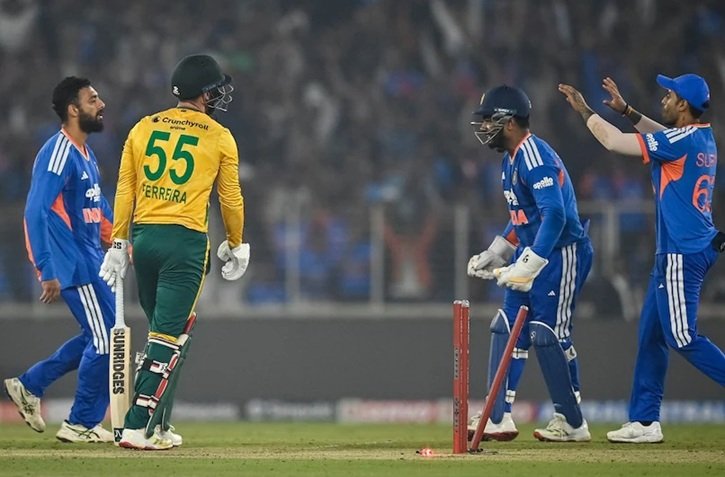
India eventually won by seven runs, securing its second men’s T20 World Cup title. Virat Kohli’s important batting contribution, Hardik Pandya’s bowling and the decisive final overs played major roles in the result. Jasprit Bumrah and Arshdeep Singh also delivered crucial spells.
For South Africa, the defeat was particularly painful because the team had an opportunity to win its first senior men’s ICC World Cup trophy. Nevertheless, its performance throughout the tournament demonstrated the quality of its T20 squad.
The Latest Chapter: India vs South Africa in 2025–26
The 2025–26 tour of India was an important recent development in the rivalry. South Africa visited India for a multi-format series featuring two Tests, three ODIs and five T20Is. The results were particularly interesting because the two teams displayed different levels of dominance across the formats.
South Africa achieved a remarkable 2–0 victory in the Test series. This was a significant achievement because the Proteas had not won a Test series in India since the 1999–2000 tour. Their performances demonstrated excellent preparation, disciplined bowling and the ability to handle challenging conditions. The result also showed that India’s home advantage could not guarantee success against a well-prepared opposition.
India responded strongly in the ODI series, winning 2–1. The matches featured high-scoring performances, aggressive batting and competitive run chases. India won the deciding third ODI by nine wickets after successfully chasing South Africa’s total of 270. This victory demonstrated the home team’s strength in limited-overs cricket.
The T20I series also produced an entertaining contest. India won the series 3–1, with one match ending without a result. Both teams experimented with combinations and gave important players opportunities to perform in the shortest format. The contrasting results across the three formats made this tour an especially interesting part of the rivalry.
The 2026 ICC Men’s T20 World Cup Meeting
Another major recent encounter occurred during the 2026 ICC Men’s T20 World Cup. India and South Africa faced each other in Ahmedabad on February 22, 2026, in a Super Eight match. South Africa produced an impressive performance, scoring 187 runs for seven wickets before dismissing India for 111.
South Africa won the contest by 76 runs, delivering a significant result against the defending champions. The match demonstrated the importance of controlling the middle overs, building partnerships and taking wickets at regular intervals. It also showed that South Africa remained capable of challenging India in major international tournaments.
As of November 3, 2026, this World Cup encounter remains the latest major meeting highlighted in the India national cricket team vs South Africa national cricket team timeline.
Head-to-Head Records Across Test, ODI and T20I Formats
Head-to-head statistics provide a useful understanding of the competitive balance between these teams. Each format has produced different results because playing conditions, team combinations and match strategies vary considerably.
Based on available records through the latest completed matches in 2026, the rivalry has the following format-wise picture:
| Cricket Format | Matches Played | India Wins | South Africa Wins | Draw/No Result |
|---|---|---|---|---|
| Test | 46 | 16 | 20 | 10 draws |
| ODI | 97 | 42 | 52 | 3 no results |
| T20I | 36 | 21 | 14 | 1 no result |
Test Cricket: South Africa Holds the Historical Advantage
Test cricket has traditionally been one of the most challenging formats for India when playing in South Africa. The Proteas have historically benefited from conditions that support fast bowling, including bounce, movement and pace. However, India’s victories at Johannesburg, Centurion and Cape Town demonstrate how much its overseas Test performances have improved.
India has also produced dominant performances at home, including the 2015–16 and 2019–20 series victories. South Africa’s 2025–26 series victory in India further underlined the competitive nature of this format.
ODI Cricket: A Closely Contested Rivalry
South Africa leads the overall ODI head-to-head record, but India has produced several impressive performances over the years. Both sides have enjoyed successful periods, and their ODI encounters frequently feature aggressive batting and competitive bowling.
The difference between their overall victories is relatively small compared with the number of matches played. This makes ODI cricket an especially interesting part of the rivalry, as either team can produce a match-winning performance.
T20I Cricket: India Has the Upper Hand
India has a stronger overall record in T20I cricket. Its success has been supported by aggressive top-order batters, versatile all-rounders and bowlers who can perform effectively in different match situations.
South Africa, however, has consistently remained competitive in the format. Its power hitters, athletic fielders and fast bowlers make it a dangerous opponent, particularly in high-pressure tournament matches.
Legendary Players Who Shaped the India vs South Africa Rivalry
The rivalry has become memorable because of the individual contributions of exceptional cricketers. Both nations have produced players who performed consistently against strong opposition and delivered match-winning performances in important situations.
India’s Most Influential Cricketers
Several Indian players have played important roles in shaping the rivalry. Sachin Tendulkar was one of the earliest major batting stars to challenge South Africa’s bowling attack. His technical ability and experience helped India compete against some of the strongest South African teams.
Virat Kohli later became one of the most influential players in this contest. His aggressive approach, consistency and ability to perform under pressure made him a central figure in India’s international success. Rohit Sharma also contributed significantly through his powerful batting and leadership, particularly in limited-overs cricket.
Other important Indian performers include:
-
Rahul Dravid: Known for his patience, technique and valuable Test performances.
-
MS Dhoni: An influential captain who guided India through several important limited-overs contests.
-
Jasprit Bumrah: A world-class fast bowler known for accuracy, variations and match-winning spells.
-
Ravichandran Ashwin: An important spin bowler who has produced several impressive performances against South Africa.
South Africa’s Most Influential Cricketers
South Africa has also produced several legendary players who have made this rivalry special. Jacques Kallis was an outstanding all-rounder who contributed with both bat and ball. AB de Villiers became famous for his innovative batting, while Hashim Amla established himself as one of the most technically accomplished batters of his generation.
The South African bowling department has also played a significant role in the rivalry. Dale Steyn, Shaun Pollock, Morne Morkel and Kagiso Rabada have troubled Indian batters with their pace, accuracy and ability to exploit different pitch conditions.
Some other notable South African players include:
-
Graeme Smith: A successful captain who led South Africa through several competitive tours.
-
Faf du Plessis: An experienced batter known for his ability to handle pressure.
-
Quinton de Kock: An aggressive wicketkeeper-batter who has produced important limited-overs performances.
-
Temba Bavuma: A key leader who guided South Africa to important victories, including the 2025–26 Test series in India.
What Makes India vs South Africa Cricket Matches Special?
There are several reasons why matches between these teams attract significant attention. One of the biggest factors is the difference in playing conditions. Indian pitches often provide opportunities for spin bowlers, while South African surfaces generally offer more assistance to fast bowlers. These differences force both teams to adjust their strategies when playing away from home.
Another important factor is the quality of players available to both sides. India has traditionally produced technically strong batters and skilled spin bowlers, whereas South Africa has developed a reputation for pace bowling, athletic fielding and powerful batting. These contrasting strengths create interesting tactical battles throughout a match.
The rivalry is also important because both teams regularly compete in major international tournaments. Their encounters in World Cups, bilateral series and other ICC competitions often carry additional significance. The 2024 T20 World Cup final and the 2026 T20 World Cup meeting are recent examples of how quickly the balance can shift between these two cricketing nations.
Future of the India vs South Africa Cricket Rivalry
The future of this rivalry looks promising because both countries continue to develop talented international players. India’s younger generation has opportunities to establish itself alongside experienced cricketers, while South Africa continues to invest in developing players capable of performing across all formats.
Test cricket will remain an important part of the relationship because it provides the ultimate examination of batting technique, bowling consistency and mental strength. ODI cricket will continue to offer opportunities for tactical competition, while T20Is are likely to attract younger audiences through their fast-paced entertainment.
The India national cricket team vs South Africa national cricket team timeline will continue to expand as both sides participate in future bilateral series and international tournaments. New players will create their own memorable moments, while established stars will aim to add further achievements to their careers.
Future encounters will also provide opportunities for both teams to improve their historical records. India will look to strengthen its performance in South African conditions, while South Africa will aim to maintain its competitiveness in India. These challenges will keep the rivalry exciting for cricket supporters.
Conclusion
The India–South Africa cricket rivalry has developed into one of the most fascinating relationships in international cricket. Since the first ODI meeting in 1991, both teams have experienced victories, defeats, challenging tours and unforgettable tournament encounters. Their performances across Test, ODI and T20I cricket demonstrate the importance of adaptability, teamwork and individual excellence.
From Sachin Tendulkar and Jacques Kallis to Virat Kohli, AB de Villiers, Jasprit Bumrah and Kagiso Rabada, several legendary cricketers have contributed to this competitive history. Recent encounters, particularly the 2025–26 multi-format series and the 2026 T20 World Cup match, have added further memorable chapters.