



Introduction
The Indian Premier League (IPL) is one of the most popular professional T20 cricket tournaments in the world. Every season, millions of cricket fans follow their favourite franchises, watch exciting matches and keep track of player performances. From powerful batting performances to impressive bowling spells, the tournament offers plenty of entertainment within a limited period. However, people who are new to cricket often have questions about the basic rules of the competition. One of the most common questions is how many overs are played in an IPL match and how the innings are structured.
The IPL follows the Twenty20 (T20) format, which makes every match shorter and more action-packed than traditional Test and One Day International cricket. In a standard match, each team gets a maximum of 20 overs to score as many runs as possible. The team batting second attempts to reach or surpass the first team’s total within its allotted overs. Although the basic format is straightforward, several rules involving powerplays, bowling restrictions, weather interruptions and tied matches influence how a game develops.
Understanding these rules makes watching IPL matches more enjoyable. It also helps fans follow scorecards, evaluate team strategies and understand why captains make particular decisions during important moments. This guide explains the number of overs, innings structure and important playing conditions that every IPL viewer should know.
How Many Overs Are Played in an IPL Match?
The standard IPL match consists of 40 scheduled overs in total, with 20 overs allocated to each team. The first team bats for a maximum of 20 overs, and after the innings break, the second team gets the same opportunity. This structure ensures that both sides have an equal chance to compete. However, an innings can finish before the allotted overs if the batting team loses all ten wickets or the chasing team reaches its target.
For example, if Chennai Super Kings score 185 runs in their allotted 20 overs, the opposing team needs 186 runs to win. The chasing team can achieve this target in fewer than 20 overs. If it reaches 186 runs after 17.3 overs, the match ends immediately, even though 2.3 overs remain. Similarly, if a team gets bowled out after 16 overs, its innings ends without using the remaining four overs.
This means that 20 overs represent the maximum allocation for each side rather than a requirement to play every delivery. The same basic principle applies to every regular IPL league-stage match and playoff match, subject to the applicable playing conditions.
Understanding the IPL T20 Match Format
The IPL follows a limited-overs cricket format known as Twenty20. Unlike Test cricket, where matches can continue for several days, or ODI cricket, where each team generally receives 50 overs, T20 cricket is designed to produce a result within a much shorter playing period. Each team receives one innings, and the maximum number of overs is 20.
When considering how many overs in ipl are available to a team, it is important to understand that each innings has its own allocation. The first team uses its 20 overs to build a competitive total, while the second team attempts to score more runs. Both teams have ten wickets available, although losing wickets does not automatically reduce the number of overs remaining.
The toss takes place before the match, and the winning captain chooses whether to bat or bowl first. This decision often depends on the pitch, weather conditions, ground characteristics and expected dew during an evening match. Some captains prefer batting first to put pressure on the opposition, while others choose to chase because they can calculate the required run rate throughout the innings.
How the Two Innings Work
An IPL match has two main innings separated by an interval. During the first innings, one team bats while the opposition bowls and fields. Once the innings is completed, the teams exchange their batting and fielding responsibilities. The second team then attempts to achieve the target set by the first team.
The innings structure creates different strategic challenges. A team batting first must balance scoring quickly with protecting its wickets. A team chasing a target needs to manage its required run rate and decide when to attack. For instance, a target of 180 runs requires a different strategy from a target of 220 runs, even though both teams have the same maximum number of overs.
IPL Overs Distribution and Match Structure
The following table explains the standard distribution of overs and the basic responsibilities of both teams.
| Match component | Standard allocation | Explanation |
|---|---|---|
| First innings | 20 overs | First team attempts to build a total |
| Innings interval | 20 minutes | Scheduled break between innings |
| Second innings | 20 overs | Second team attempts to chase the target |
| Total scheduled overs | 40 overs | Maximum for both regular innings combined |
| Powerplay | First 6 overs | Special fielding restrictions |
| Maximum overs per bowler | 4 overs | Individual bowling limit |
The distribution remains the same in an uninterrupted match, although actual playing time can vary because of wickets, reviews, time-outs, injuries and other stoppages. The IPL playing conditions also specify an expected over rate so that teams complete their innings within the scheduled time.
What Is the Powerplay in IPL?
The Powerplay is one of the most important phases of an IPL innings. It refers to the opening six overs, during which special restrictions apply to the placement of fielders. These restrictions are designed to encourage attacking batting and create opportunities for early wickets. During the Powerplay, a maximum of two fielders can remain outside the 30-yard fielding restriction area at the moment the ball is delivered.
This arrangement gives opening batters more opportunities to find gaps and score boundaries. Since fewer fielders are positioned near the boundary, well-timed shots can travel for four or six runs. However, the fielding team also has an opportunity to take advantage of aggressive batting by attacking the stumps and using fast bowlers or swing bowlers.
After the Powerplay finishes, the fielding restrictions change. During the remaining overs, a maximum of five fielders can be positioned outside the fielding restriction area, subject to the applicable playing conditions. Captains can then use different field placements to control scoring opportunities and create pressure on the batting side.
Why the Powerplay Matters
The first six overs often influence the direction of an entire innings. A strong opening partnership can provide a team with a solid foundation, while early wickets can force the middle-order batters to adopt a more cautious approach.
For example, a team scoring 60 runs without losing a wicket during the Powerplay puts itself in a strong position to accelerate later. On the other hand, a team losing three early wickets might need to rebuild its innings before attempting aggressive shots. This is why opening batters and new-ball bowlers play such important roles in T20 cricket.
How Many Overs Can a Bowler Bowl in IPL?
Although each team receives a maximum of 20 overs to bat, an individual bowler cannot bowl all 20 overs. The IPL has a specific bowling restriction that allows each bowler to deliver a maximum of four overs in a standard uninterrupted innings. This rule ensures that teams distribute their bowling responsibilities among multiple players rather than depending on a single bowler.
A team generally uses five or more bowlers to complete its 20-over allocation. For example, four bowlers can deliver four overs each, while another bowler can complete the remaining four overs. Captains may also use additional bowling options depending on match conditions, player performance and the opposition’s batting strength.
The bowling allocation is particularly important in the final overs. Teams often save their most effective death-over bowlers for the closing stages because batters usually attempt more aggressive shots during this period. A good bowling combination can prevent the opposition from scoring freely and make a significant difference to the final result.
Bowling Restrictions in Different Situations
The maximum four-over limit applies to a regular 20-over innings. However, if rain or another interruption reduces the number of available overs, the bowling restrictions are adjusted according to the revised innings length.
For innings of ten or more overs, the maximum bowling allocation is generally calculated using one-fifth of the total overs, with an additional over where necessary to distribute the remaining allocation. For innings shorter than ten overs, no bowler can deliver more than two overs. These adjustments help maintain a reasonable balance between batting and bowling opportunities.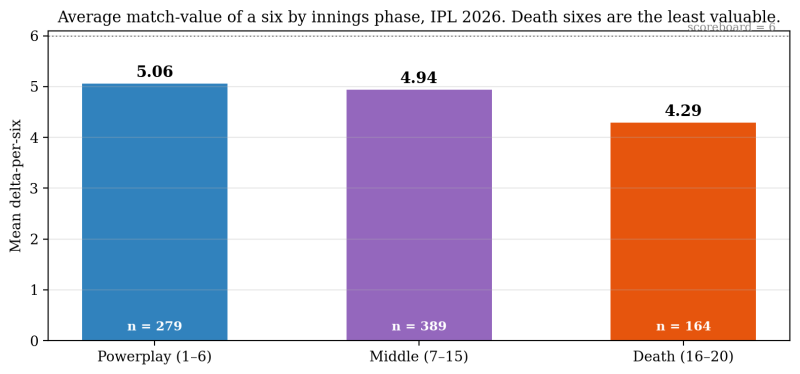
Different Phases of an IPL Innings
Although an innings contains 20 overs, teams usually divide it into three strategic phases: Powerplay, middle overs and death overs. Each phase has a different purpose, and players adjust their approach depending on the match situation.
1. Powerplay Overs (1–6)
The opening six overs are known as the Powerplay. During this period, batters generally try to score quickly because fielding restrictions create more opportunities for boundaries. Opening partnerships are particularly important because a good start can increase the scoring rate and provide confidence to the middle order.
Bowlers, meanwhile, try to use swing, seam movement and changes in pace to dismiss opening batters. Captains often position fielders carefully to prevent easy boundaries while keeping attacking options available.
2. Middle Overs (7–15)
The middle phase begins after the Powerplay and continues through the fifteenth over. During this period, teams generally focus on maintaining momentum while protecting important wickets. Batters may rotate the strike, target weaker bowling options and choose particular overs for aggressive scoring.
Spinners often play an important role during this stage because they can change the pace of the game and create pressure through variations in flight and turn. However, aggressive batters can also target spinners, making captaincy and field placement important.
3. Death Overs (16–20)
The final five overs are commonly called the death overs. This is usually the most aggressive phase of an IPL innings because batters try to score as many runs as possible before their innings ends. Big hits, yorkers, slower deliveries and clever field placements become especially important.
A team with wickets remaining can take greater risks during this stage. For example, if a side has scored 150 runs after 15 overs with seven wickets still available, it may attempt to score another 60 or 70 runs in the final five overs. However, losing quick wickets can reduce its scoring opportunities.
How Many Overs in IPL When Rain Interrupts a Match?
Weather conditions can sometimes interrupt IPL matches, especially during periods of heavy rainfall. When rain prevents normal play, the umpires and match officials assess the remaining time and determine whether the innings can continue with a reduced number of overs.
In such situations, the original 20-over allocation may be reduced for both teams or adjusted for the second innings. The objective is to provide both sides with a fair opportunity to compete within the available playing time. The revised number of overs depends on the length of the interruption and the time remaining in the match.
The Duckworth-Lewis-Stern (DLS) method is used to calculate revised targets in qualifying interrupted matches. This system considers resources such as overs remaining and wickets available. It helps establish a revised target that reflects the circumstances of the shortened game rather than simply reducing the target by a fixed number of runs.
Minimum Overs Required for a Result
Under the 2026 IPL playing conditions, a minimum of five overs generally needs to be available to the team batting second for a result to be possible. There are exceptions when a result has already been achieved earlier, such as when the chasing team reaches its target before completing five overs.
If the required minimum opportunity is not available and no result has already been achieved, the match is generally declared a No Result. In league-stage matches, this can affect the points table and each team’s qualification prospects.
What Happens When an IPL Match Is Shortened?
A rain-affected match does not necessarily mean that the game will be cancelled. Officials try to use the available playing time to arrange a shortened contest. For example, if weather conditions allow only ten overs per side, both teams may play a ten-over innings instead of the regular 20-over format.
In another situation, the first team might complete its full innings before rain interrupts the second innings. If play resumes with fewer overs available, the chasing team’s target may be recalculated using DLS. This is why viewers sometimes see a revised target and a different number of overs on the scoreboard after a weather interruption.
What Happens If an IPL Match Ends in a Tie?
An IPL match can end in a tie when both teams finish with the same score after their innings have been completed. In such circumstances, a Super Over is used to determine the winner, provided the playing conditions allow it to take place.
A Super Over is a separate one-over contest in which both teams get an opportunity to bat. Each side faces a maximum of six legal deliveries, unless its innings ends earlier because it loses two wickets or reaches the winning target. The team scoring more runs in the Super Over wins the contest.
If the first Super Over also ends in a tie, additional Super Overs are played until a winner is determined, subject to the applicable match conditions and available time. The team that batted second in the main match bats first in the initial Super Over.
For example, imagine two teams both score 175 runs in their regular innings. A Super Over is then organised to decide the result. If the first team scores 12 runs and the second team scores 13, the second team wins. This additional contest creates an exciting finish and gives spectators another opportunity to see a close competition.
How Are Overs Counted in IPL Cricket?
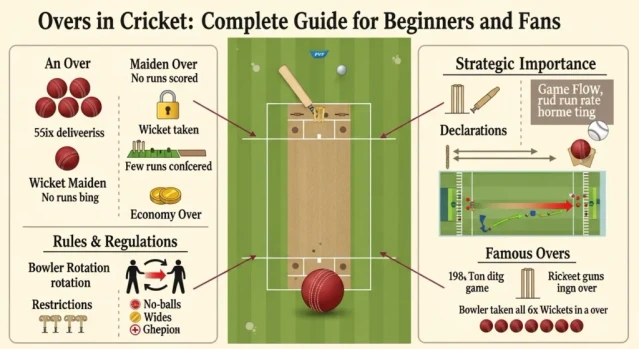
For new cricket viewers, understanding the way overs are counted can make scorecards much easier to follow. One over consists of six legal deliveries bowled by a single bowler from one end of the pitch. After completing an over, the bowling end changes, and another bowler delivers the next over from the opposite end.
It is important to understand that wides and no-balls do not count as legal deliveries. Therefore, a bowler may need to deliver more than six actual balls to complete an over. For example, if a bowler delivers one wide and then six legal deliveries, the over contains seven actual deliveries but is recorded as one completed over.
Understanding Over Notation
Cricket scorecards use a special notation to show the number of completed overs and additional legal deliveries. For example, 15.3 means 15 completed overs and three legal balls from the next over. It does not mean 15.3 decimal overs.
This distinction is useful when calculating run rates. Since an over contains six legal balls, 15.3 overs represents 93 legal deliveries rather than 15.3 decimal overs. Understanding this calculation helps fans read match statistics and follow the progress of an innings accurately.
Why the 20-Over Format Makes IPL Exciting
The 20-over format is one of the major reasons behind the popularity of the IPL. It combines competitive cricket with a relatively short match duration, allowing viewers to enjoy batting, bowling and fielding performances within a single evening. Every delivery can influence the match, particularly when teams are chasing challenging targets or defending small totals.
The limited number of overs also encourages innovative strategies. Batters develop different shots to score boundaries, bowlers use variations to control scoring and captains regularly adjust their field placements. A team cannot depend entirely on one player because each phase of the innings creates different challenges.
Another interesting aspect is that a low-scoring match can be just as competitive as a high-scoring contest. A team defending 140 runs can still win if its bowlers perform exceptionally well. Similarly, a side chasing 200 runs can create an exciting finish through a strong batting partnership. These possibilities make the IPL unpredictable and entertaining.
Conclusion
Understanding the IPL’s over system is essential for anyone who enjoys watching T20 cricket. The standard format provides each team with a maximum of 20 overs, creating a total of 40 scheduled overs in a regular match. The Powerplay, middle overs and death overs each have different strategic purposes, while bowling restrictions ensure that teams distribute their resources effectively.
For viewers searching for how many overs in ipl, the simple answer is 20 overs per team in a normal uninterrupted match. However, weather interruptions, revised targets and Super Overs can create additional situations that change how a match is played. Knowing these rules makes it easier to understand scorecards, follow team strategies and enjoy every stage of the competition.
As the IPL continues to attract cricket fans, its fast-paced format remains an important part of its appeal. Whether you are a regular viewer or a beginner learning the rules, understanding the 20-over structure will help you appreciate the excitement, planning and competitive spirit behind every match.